

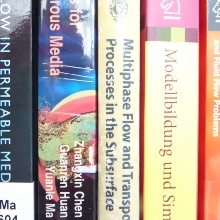
Allgemeines
Die Lehrveranstaltungen behandeln die Grundlagen der Fluidmechanik in den Veranstaltungen Fluidmechanik I und II, die Modellierung von Hydrosystemen, die Beschreibung von Austausch- und Transportprozessen in Strömungen sowie weiterführende Veranstaltungen zur Theorie und Numerik zu Strömungen und Transport in porösen Medien. Neben den Vorlesungsveranstaltungen, die in deutscher und zum großen Teil auch in englischer Sprache gehalten werden, gibt es verschiedene Seminare in Zusammenarbeit mit anderen Fakultäten, z.B. im Rahmen des SRC SimTech. Darüber hinaus sollen auch Studierende anderer Disziplinen, wie z.B. der Mathematik, Informatik, oder der Verfahrenstechnik angesprochen werden.
Lehrangebote
Sommersemester:
- Ausbreitungs- und Transportprozesse in Strömungen
Betreuerin: Jun.-Prof. Maartje Boon
Mehr Information: Modul - Environmental Fluid Mechanics II
Betreuerin: Jun.-Prof. Maartje Boon
Mehr Information: Modul
- Fluidmechanik I
Betreuer: Roman Winter (M.Sc.)
Betreuer: Yue Wang (M.Sc.)
Mehr Information: Modul
- Modeling of Hydrosystems
Betreuer: Dr. -Ing. Felix Weinhardt
Mehr Information: Modul - Sustainable development of simulation software
Betreuer: Dr. -Ing. Dennis Gläser
Mehr Information: Modul
- Multiscale models, methods and numerics
Betreuer: Ph.D. Tufan Ghosh
Mehr Information: Modul
Wintersemester:
- Numerische Methoden der Fluidmechanik
Betreuer: Mathis Kelm (M.Sc.)
Mehr Information: Modul - C++-Kurs für SimTech
Betreuer: Ivan Buntic (M.Sc.)
Mehr Information: Modul - Environmental Fluid Mechanics I
Betreuer: Dr.-Ing. Johannes Hommel
Betreuer: apl. Prof. Dr.-Ing. Sergey Oladyshkin
Betreuer: Dr.-Ing. Simon Kleinknecht
Mehr Information: Modul - Fluidmechanik II
Betreuer: Roman Winter (M.Sc.)
Betreuer: Yue Wang (M.Sc.)
Mehr Information: Modul - Grundwassererschließung und Grundwasserschutz
Betreuer: Tim Jupe (M.Sc.)
Mehr Information: Modul - Mehrphasenmodellierung in porösen Medien
Betreuerin: Stefanie Kiemle (M.Sc.)
Betreuer: Kerem Bozkurt (M.Sc.)
Mehr Information: Modul - Modelling Surface Water Systems
Betreuer: Maziar Veyskarami (M.Sc.)
Mehr Information: Modul - Multiphase Modeling in Porous Media
Betreuerin: Stefanie Kiemle (M.Sc.)
Mehr Information: Modul - Data-integrated Simulation Science A
Betreuer: Dr. -Ing. Martin Schneider
Mehr Information: Modul - Modelling and Analysis of Coupled Systems
Betreuer: Ph.D. Tufan Ghosh
Mehr Information: Modul
Seminare / Kurse
- Dumux Course
More information on Dumux website - Interpore-Short Course "Porous Media Free Flow Coupling"
Date: 14.11.2022-12.12.2022
Lecturer: Prof. Rainer Helmig - Interpore-Short Course "Transport of Viruses and colloids in variably-saturated porous media"
Date: 21.09.2021, 24,09.2021
Lecturer: Prof. Majid Hassanizadeh - Interpore-Short Course "Porous Media Free Flow Coupling"
Date: 08.11.2021 - 11.11.2021
Lecturer: Prof. Rainer Helmig
BSc./MSc.-Angebote
Liebe Studierende,
wir freuen uns, dass Sie sich für eine studentische Arbeit an bzw. mit unserem Lehrstuhl interessieren.
Hier finden Sie die Liste von Mitarbeitern und Mitarbeiterinnen, die neue spannende Themen anbieten und betreuen.
Themengebiete
- Experimental and Numerical Investigations of Thermal Diffusion in Hydrophilic Gas Diffusion Layers in PEM Fuel Cells
Weitere Informationen
Betreuer: Kerem Bozkurt (M.Sc.) - Experimental and/or numerical investigations on microbially induced calcite precipitation and biofilm in microfluidic porous media
Weitere Informationen
Betreuer: Kerem Bozkurt (M.Sc.), Dr. Felix Weinhardt - Anwendung bestehender Modelle zur Simulationen von reaktivem Transport in porösen Medien, insbesondere von induzierte Kalkausfällung (IK), und den damit einhergehenden Änderungen im porösen Medium.
Betreuer: Dr.-Ing. Johannes Hommel - Vergleich von Simulationsergebnissen mit experimentellen Daten oder numerische Untersuchungen zur Bewertung verschiedener, realistischer Anwendungsalternativen von IK. Begrenzt auch experimentelle Studien zu IK.
Betreuer: Dr.-Ing. Johannes Hommel - Untersuchung von bei Gemälderestauration auftretenden Prozesses mit Hilfe von Porennetzwerkmodellierung
Weitere Information
Betreuer: Dr.-Ing. Johannes Hommel - Gitterverfeinerung für die Finite Volumen Methode auf verschobenen Gittern.
Betreuerin: Melanie Lipp (M.Sc.) - Koppling von freier Strömung und Strömung in porösen Medien.
Betreuer: Edward Coltman (M.Sc.) - Simulation von Verdunstungsvorgängen in der ungesättigten Zone.
Betreuer: Edward Coltman (M.Sc.) - Turbulenzmodellierung.
Betreuer: Edward Coltman (M.Sc.) - Experimentelle und/oder (je nach Wunsch oder aktueller Erfordernis) numerische Untersuchungen zu vertikaler Migration von Kohlendioxid, das sich aus Höhlenluft in Wassersäulen einlöst.
Betreuer: apl. Prof. Dr.-Ing. Holger Class - CO2 sources and sinks in soils and CO2 fluxes in the vadose zone: a modelling study towards assessing their potential role for carbon budget models.
Betreuer: apl. Prof. Dr.-Ing. Holger Class - Realisierung eines allgemeinen Advektions-Diffusions-Modells in DuMuX.
Betreuer: Dr. -Ing. Martin Schneider - Non-Newtonian Fluid Flow through Porous Media.
Betreuer: Tufan Ghosh (PhD) - Mixed-dimension coupling methods with distributed sources for two-phase flow problems in porous media.
Betreuer: Hanchuan Wu (M.Sc.) -
Investigation of transmissibility development due to precipitation processes in pore-network models using a thin-strip concept. Weitere Information
Betreuerin: Theresa Schollenberger (M.Sc.)
Bitte nehmen Sie einfach je nach Interesse an einem der genannten Bereiche Kontakt zu den Kolleginnen und Kollegen auf. Oder kontaktieren Sie Holger Class oder Rainer Helmig per Email.
Der Lehrstuhl für Hydromechanik und Hydrosystemmodelierung pflegt im Rahmen des Erasmus-Austausch-Programms die Kontakte zu folgenden Partneruniversitäten:
Universiteit Utrecht,Niederlande
http://www.uu.nl
Universitetet i Bergen, Norwegen
http://www.uib.no
Politechnika Gdanska, Polen
http://www.pg.gda.pl
Politecnico di Torino
https://www.polito.it/
Fachspezifische Beratungsgespräche werden von Herrn Mathis Kelm nach vorheriger Terminvereinbarung und einer Erstberatung von Seiten des IZ durchgeführt.
Kontakt internationales Zentrum (institutional coordinator):
Pfaffenwaldring 60
Webseite: Informationsseite der Auslandsstudienberatung
Termin nur nach Vereinbarung!
Kontakt Institut für Wasser- und Umweltsystemmodellierung (departmental coordinator)
Mathis Kelm (M.Sc.)
Termin nur nach Vereinbarung!
Die Ferienakademie wurde im Jahr 1994 durch Prof. F.L. Bauer von der TU München gegründet. Im Jahr 1985 wurde die Universität Erlangen-Nürnberg die zweite ausrichtende Universität. Die Universität Stuttgart folgte im Jahr 2002. Seit 2005 wird die Ferienakademie von Prof. H.-J. Bungartz von der TU München geleitet.
Spenden von Firmen und von Fördervereinen der drei veranstaltenden Universitäten und Eigenmittel ermöglichen die Durchfürung der Ferienakademie im Sarntal in Südtirol. Sie soll der Motivation und der Förderung begabter und interessierter Studierender der drei veranstaltenden Universitäten dienen.
Sprechstunden
Allgemeine Fragen zur Lehre/Prüfungsangelegenheiten: nach Vereinbarung
Kontakt
Leon Keim
M. Sc.wissenschaftlicher Mitarbeiter
Anna Mareike Kostelecky
M. Sc.wissenschaftliche Mitarbeiterin
Johannes Hommel
Dr.-Ing.wissenschaftlicher Mitarbeiter